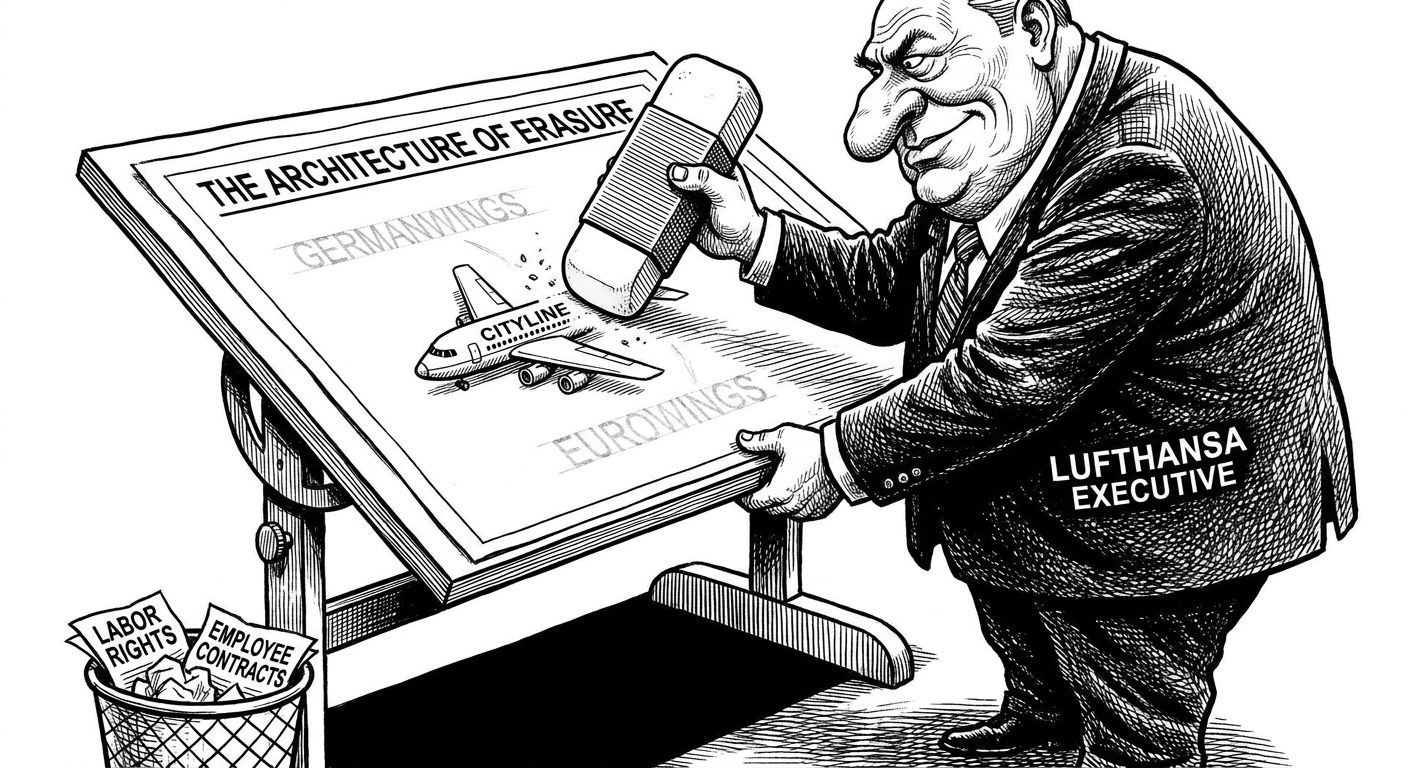
Luftscamsa - How Lufthansa Weaponizes Subsidiaries Against Labor
For twenty years, Deutsche Lufthansa AG has pursued a consistent policy of shutting down unionized subsidiaries to replace them with entities operating under lower-cost labor contracts. The executive board methodically isolates the workforce into silos of diminished bargaining power to preemptively settle labor disputes by liquidating established entities. This approach prevents collective bargaining from hindering the group's financial objectives and ensures that new, cheaper platforms emerge whenever wage costs approach market-standard levels. Historical Patterns of Restructuring The group’s history includes several documented instances where corporate entities were dissolved specifically to reset labor costs. The CityLine Erasure The most recent iteration of this strategy reached its conclusion in April 2026 with the abrupt closure of Lufthansa CityLine. Management accelerated the shutdown—moving it ahead of a scheduled 2027 end date—to preemptively strike during a volatile contract negotiation period. By liquidating the entity, the group effectively voided the collective bargaining agreements that had previously protected its pilots and crew. Lufthansa created "Lufthansa City Airlines" as a distinct entity with a separate Air Operator's Certificate and a different collective agreement. This allowed the company to deploy larger narrowbody aircraft—previously restricted by mainline scope clauses—at significantly lower labor costs. Employees were presented with an ultimatum: accept employment with the new low-cost subsidiary under inferior terms or face unemployment. The Tyrolean Erasure The practice of using subsidiaries to bypass labor costs is a documented institutional legacy. In July 2012, facing resistance from mainline unions, Lufthansa Group unilaterally transferred Austrian Airlines' flight operations and 3,000 employees to its regional subsidiary, Tyrolean Airways. This forced migration aimed to strip workers of their established collective agreements. The maneuver was eventually deemed illegal; in September 2014, the European Court of Justice and the Vienna Labor and Social Affairs Court dictated that original collective agreements remained legally binding. Following this defeat, management was forced to re-integrate operations back into the main Austrian Airlines brand by April 2015, effectively dissolving the Tyrolean experiment. The Germanwings Erasure Lufthansa’s management frequently employs rebranding to reset labor costs. The transformation of Germanwings into Eurowings served as a vehicle to dismantle legacy contracts under the guise of operational synergy. Following systemic failures and ongoing labor friction, the group opted to shift assets to a more flexible, lower-cost platform, resetting labor costs in the process. This behavior created a permanent atmosphere of existential insecurity. By ensuring that no single labor union can exert control over fragmented subsidiaries, the executive board maintains a strike-resistant network. Each new entity—whether it is the leisure-focused Discover Airlines or the Malta-based Eurowings Europe Limited—acts as a firewall against the demands of the mainline workforce. By utilizing "flags of convenience" in jurisdictions like Malta, the group exploits relaxed labor regulations to make effective organization or legal striking nearly impossible for its crews. The Swiss Global Erasure While management often succeeds in its fragmentation, the SWISS example demonstrates that labor harmonization can neutralize these strategies. Swiss Global Air Lines was created as a regional subsidiary to foster a two-tier wage system. However, in 2018, the pilot union successfully negotiated a collective labor agreement that harmonized compensation across the mainline and the subsidiary. Because this eliminated the lower-cost advantage of the subsidiary, management immediately dissolved the unit and re-integrated the aircraft and crew into the SWISS mainline. Long-Term Operational Consequences Management frames these actions as "flexibility" or "economic necessity." The evidence indicates that the primary result is a long-term erosion of operational integrity. As established in [past Pax Sentinel investigations](/en/article/Wei7evGg_safety-protocols-compromised-by-labor-dispute), the group’s reliance on these tactical maneuvers often precedes periods of staffing shortages and safety compromises. By sacrificing the stability of its internal labor force for the sake of short-term cost arbitrage, the executive board has manufactured a cycle of permanent unrest.